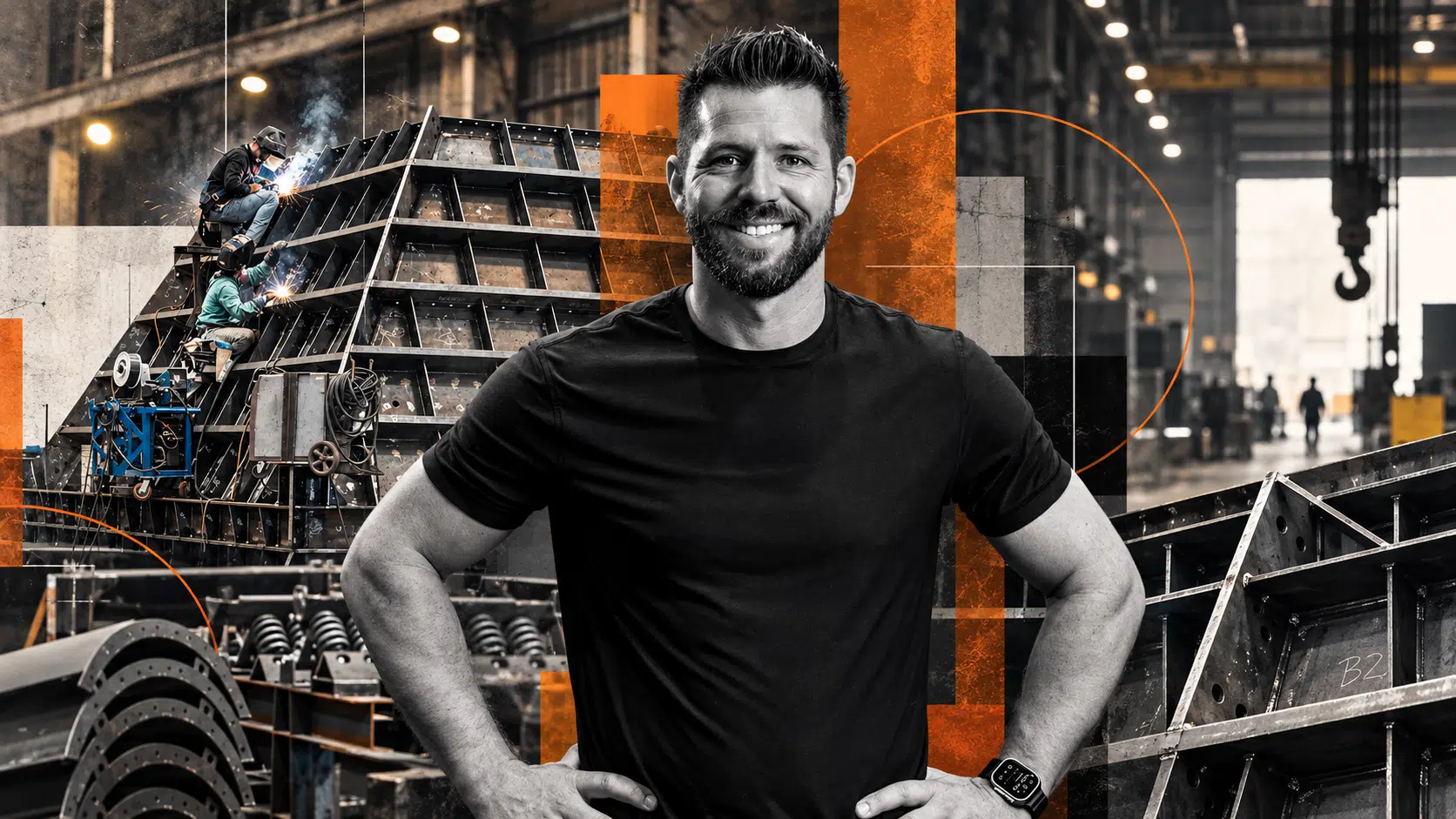
When I ask Constantin Haag what Hammer Haag Steel does, he does not start listing products, services or equipment like most manufacturers would.
“We sell certainty,” he says.
It sounds like a slogan until Haag explains what certainty means in practice.
“We started Hammer Haag Steel because there weren’t many great fabricators,” he says. “We wanted to bring everything in-house and control the service and quality to the standard I would want as a customer.”
That instinct—to control the difficult parts rather than depend on someone else to get them right—has shaped the company ever since.
Haag’s path into manufacturing began years earlier. He moved from Germany to Clearwater, Florida, when he was 6 and began taking on responsibilities in his father’s company as a teenager. He worked through nearly every part of the operation: design, field installation, manufacturing and mechanical assembly. Even today, as founder and president, he talks about the business like someone who still has his hands on the work.
But Hammer Haag’s real breakthrough came after its launch in 2011.
The company opened with six people in a 15,000-square-foot facility, with early work in the power and amusement industries. The work was technically demanding, highly customized and difficult for others to execute consistently. As Hammer Haag developed its fabrication capabilities, it applied them across a growing mix of industries, giving the young company a broader base of work and helping shape what made the operation unique.
That forced the question: Where else are these capabilities valuable?
The answer changed the trajectory of the company.
Haag’s experience across demanding projects and multiple industries showed him that Hammer Haag’s strength was not tied to one application. The company had developed the ability to fabricate and deliver complicated industrial projects where precision, coordination and reliability were required.

As Hammer Haag developed those capabilities across a wider range of industries, the market available to the company expanded dramatically. Cranes, bulk-material-handling equipment, mining, industrial machinery and other custom projects followed.
It is a strategy that echoes a principle articulated by industrial billionaire Charles Koch: “First of all, you understand what your capabilities are, and then you identify the opportunities for which they can create the most value.”
In Koch’s management philosophy, the idea is to become capability-bound rather than industry-bound. A company does not have to remain confined to the market in which it first developed a particular capability. It can take difficult, transferable capabilities and apply them wherever those capabilities solve valuable problems.
Hammer Haag arrived at essentially the same principle through experience. As the company worked across different industries and applications, Haag saw that the same fabrication and manufacturing capabilities could be applied to a much broader range of difficult projects.

Our only limitation is our client’s imagination. — Constantin Haag
That diversification solved one problem and exposed another.
As Hammer Haag took on larger and more complicated work, Haag discovered that capability alone did not guarantee control.
A weldment fabricated correctly in his shop might still have to leave for machining. Components built to specification individually still had to come together correctly during assembly. Inspection, finishing and dimensional verification introduced additional schedules and vendors. Some completed structures were too large for conventional transportation.
Every handoff created another place where the certainty Haag wanted to sell could break down.
That left Haag with a recurring question: Should Hammer Haag become better at managing a critical outside process, or develop the capability to perform it internally?
When the activity was important enough to the outcome, Haag often chose to bring it inside.
Large CNC machining came alongside fabrication. Inspection, trial fitting, assembly and finishing followed. The company developed logistics capabilities for moving unusually large structures and invested in systems to track materials and production as work moved through the shop.
Haag was not pursuing vertical integration for its own sake. He was identifying points where Hammer Haag could lose control of an outcome and deciding which were important enough to bring under one roof.
That approach carries a cost.
When a critical process moves inside, Hammer Haag also assumes responsibility for the equipment, the operator, maintenance, training and the workload needed to justify the investment. In some cases, the company duplicates that investment to create redundancy, reducing the risk that a customer’s schedule depends on a single machine or operation.
Every capability brought inside exchanges supplier dependence for greater management responsibility.
That trade is becoming more consequential across manufacturing. The National Association of Manufacturers reported in its third-quarter 2026 outlook that manufacturers expected raw-material and other input costs to increase 5% over the following year. At the same time, respondents projected capital investment to grow at its fastest rate in more than four years.
Haag has been making his own version of that calculation for years.
Hammer Haag is now investing $37.5 million in a self-funded second-site expansion, adding manufacturing space, lifting capacity and room for a larger workforce.

But Haag does not talk about buying equipment as though buying it creates capability.
Buying the machine begins the investment. Hammer Haag then has to train people to operate and maintain it, integrate the process with the work around it and generate enough throughput to justify ownership.
Which brings the story back to people.
“Everyone who works for me knows that they can contribute to their families, to the community and on the job,” Haag says.
The labor market makes that part of the equation increasingly difficult to ignore. The Bureau of Labor Statistics projects nearly 1 million openings in production occupations each year, on average, from 2024 through 2034, primarily because workers will retire, leave the labor force or move into other occupations. That is replacement demand rather than a forecast of 1 million newly created jobs, but it illustrates the scale of the workforce challenge facing manufacturers.
For Hammer Haag, adding physical capacity without adding human capability would solve very little.
The company cross-trains employees because custom manufacturing rarely repeats itself neatly. A large machined weldment may be followed by a long structural assembly requiring an entirely different combination of fitting, welding, machining, inspection and rigging. Haag cannot build the operation around the assumption that one experienced person will always be available for one specialized task.
His projects make that unpredictability unusually visible. But the operating principle behind them is broadly applicable.
Hammer Haag’s growth can be understood as a three-part progression.
First, follow the capability.
Do not assume the product that created the company defines the market available to it. Identify what the organization has become unusually good at doing and look for other valuable problems that require the same capability.
Second, follow the handoffs.
Map where responsibility for the outcome leaves the organization. Every recurring vendor dependency, information transfer, scheduling conflict or quality problem is a potential point where control, and ultimately the customer experience, can deteriorate.
Third, internalize selectively.
Do not bring something inside simply because you can. Ask whether controlling that step materially improves quality, speed, reliability or the ability to take on work competitors cannot. If it does, determine whether the company can support the equipment, systems and people required to make that capability durable.
The process then repeats.
Capability creates opportunity. Opportunity exposes constraints. Constraints reveal the next capability worth building.
That is the flywheel Haag has been turning since Hammer Haag was founded.
It also explains why his original answer to what Hammer Haag sells matters.
The cranes, machines, structures and fabricated assemblies change from project to project. The equipment inside the company will continue to change. Even the industries it serves may change.
The product, in that sense, was never the point.
What Hammer Haag has spent 15 years building is an organization capable of taking more of the uncertainty surrounding difficult industrial work and putting it under its own control.
That is what makes Haag’s statement less slogan than operating model:
“We sell certainty.”