I spend much of my working life sitting across the table from successful business owners. People who built companies from nothing. People who make high-stakes decisions before lunch and don’t lose sleep over them. They can walk you through their growth strategy, their competitive positioning, and their plans for the next three years in impressive detail.
But ask them one simple question and the room goes quiet: What happens to this business if you’re not here tomorrow?
Before launching my own firm, I spent seven years working inside a family office advisory group, advising business owners and high-net-worth families on how to protect and transfer what they’d built. I got to see how the most enduring enterprises approach this question compared to everyone else. And the gap is striking. The most successful builders tend to spend almost all of their strategic energy on offense and almost nothing on defense. And I’d argue that’s one of the biggest leadership blind spots in business today.

The “I’ll Get to It” Problem
I get why founders avoid this work. These are conversations about mortality, loss of control, and the possibility that the thing you poured your life into might need to function without you. That’s uncomfortable for anyone. It’s especially uncomfortable for people whose identity is tied to being the one who makes it all go.
So it gets pushed down the priority list. After the next round of growth. After the next deal closes. After things calm down. And in the meantime, incredibly valuable businesses are operating with glaring structural vulnerabilities that their founders and leaders don’t think about until it’s too late.
Here’s what I see regularly: Business partnerships with poorly drafted or un-funded buy-sell agreement, meaning if one partner dies or becomes disabled, there’s no plan and no money in place to handle the transition of ownership.
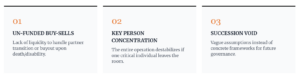
Key person concentration, so the departure of one critical individual can destabilize the entire operation. No real succession framework, just a vague assumption that somebody will figure it out when the time comes.
These aren’t abstract risks. I’ve seen what happens when they go unaddressed. Businesses get stuck in litigation between partners’ families. Valuable companies get sold in fire sales because there’s no liquidity to keep things running during a transition. Employees lose their livelihoods because no one planned for continuity. It’s not dramatic to say that a single missing document or a single unaddressed scenario can unravel decades of work.
The irony is that the qualities that make someone a great builder are often the same ones that create this blind spot. Entrepreneurs are wired to move fast, take risks, and focus on what’s in front of them. The slow, deliberate, somewhat uncomfortable work of planning for your own absence feels like the opposite of everything that got you here. But that’s exactly why it matters.
What Forward-Thinking Business Owners Actually Do
Over the years, I’ve worked with enough business owners to see a clear pattern separating the ones who build resilient companies from the ones who build fragile ones. It comes down to a few key disciplines.
They Treat Business Protection with the Same Seriousness as Growth
The most disciplined operators I’ve worked with give as much strategic attention to protecting their business as they do to growing it. They have funded buy-sell agreements that are reviewed regularly and structured to address what actually happens to ownership when a partner dies, retires, or becomes incapacitated. They’ve identified who their key people are and have protections in place so the company isn’t crippled by a single departure. They treat these things as core business strategy, not as paperwork to check off.
They Stress-Test Their Company Against Their Own Absence
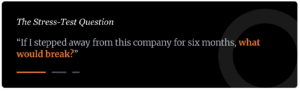
This is the real mindset shift. The best business owners I’ve observed ask themselves a version of this question on a regular basis: “If I stepped away from this company for six months, what would break?” Not because they’re planning to leave, but because a business that can only function with the founder in the room is a fragile business.
That question leads to building systems, developing people, documenting institutional knowledge, and making sure that the company’s value isn’t trapped inside one person’s head. It’s the difference between building a business and building a business that lasts.
The Real Test of Leadership
The two biggest long-term threats to anything you build are erosion and division. Erosion happens through taxes, lawsuits, and unprotected exposure that slowly eats away at what you’ve created. Division happens when there’s no structure for how things carry forward, and what was once a unified enterprise gets fragmented by transitions that nobody planned for.
Both are preventable. But only if you’re willing to do the work before you need to.
If you’ve built something valuable, then the question isn’t about your ability to grow it further. The question is whether what you’ve built can survive a bad day. Can it survive your absence, even a temporary one? Can it weather a partner dispute, an unexpected departure, a health crisis?
This isn’t about being morbid or pessimistic. It’s about leading well. The best leaders don’t just build great companies. They build companies that last.