“What we’ve got here is… a failure to communicate.”
Those words, sampled by Axl Rose in Guns N’ Roses’ “Civil War,” still land. They point to an old problem. Not just a little problem, but likely the problem behind all wars, behind the battle of the -ologies and the isms and the problem behind the issues we face in interpersonal relations everyday.
But it seems we’ve got a new solution.
For thousands of years the Tower of Babel story warned us: one language split into many, and people stopped understanding each other. We built walls out of words. We assumed the folks on the other side were too different to connect with. Middlemen—media, translators, gatekeepers—did the talking for everyone. Then this past week on X those walls started coming down.
The platform rolled out real-time auto-translation powered by Grok and the big AI systems Elon Musk has been building. Posts in any language now appear clearly in your own. When you comment, it auto translates for them. A German grandmother, a Japanese salaryman, a Russian fisherman, a Brazilian artist, and someone in Florida can all scroll the same feed and actually read what the others are saying. The old clunky translation tools are gone. The jokes land. The tone comes through. People are just talking.
The reactions showed up fast.
Ich denke seit Tagen darüber nach, was es bedeutet, dass sich plötzlich die ganze Welt auf X miteinander unterhalten kann. Den wenigsten dürfte die Vielschichtigkeit aller Auswirkungen, die dies nach sich zieht, bewusst sein.
Die Reaktionen weltweit in den ersten Tagen waren:… pic.twitter.com/i57MOFJZzn
— GFrei.News (@GFreiNews) April 11, 2026
One post put up four everyday scenes: cherry blossoms at night reflected in water, a full Texas barbecue spread, someone ice fishing in the snow, and Bavarian dancers in traditional dress spinning hoops on a field. Another user called the translation feature the most impressive tech release in years and said Elon and the X team deserved a Nobel Peace Prize for it. The half-joke worked because the change felt real.
I noticed the difference in my own feed within the first day.
Posts in any language now appear clearly in your own. When you comment, it auto translates for them.
Normally, when something from Russia, Spain, Portugal, Korea, or Japan came up, it didn’t. The algorithms on every major platform kept foreign-language posts out of sight. Developers knew most people didn’t want to scroll text they couldn’t read. It wasn’t done out of spite—just the practical call that there wouldn’t be much engagement. Social networks, news sites, Google—everyone filtered it the same way. We stayed digitally separated because good translation wasn’t there yet.
Now the separation is gone.
Suddenly a guy named Dmitri wasn’t just “some Russian.” He wasn’t the character I’d seen in movies and news clips for years—the scowling figure in a run-down apartment block who supposedly hated the West and everything it stood for. He wasn’t the villain from the old stories.
He was ordinary. He posted a photo of late sunlight on church domes in his city with a caption that sounded like the way I’d describe a sunset over the Gulf. He made dry comments about work bureaucracy that could have been mine. His jokes had the same timing and self-deprecating style I swap with friends. He pointed out small details most people notice: a musician playing on a busy street, steam rising off a hot drink on a cold day. He looked at the world the same way I do.
That shift happened fast. One minute the distance was there; the next it wasn’t. Relatability does that. When someone’s observations, humor, and everyday tastes line up with yours, the old categories stop fitting.
Jason Says the Auto-Translate Feature on X is the ‘Most Impressive Tech Feature Released in Years’
“Elon and the X team should get a Nobel Peace Prize award for this.” pic.twitter.com/oVyo99rvBB
— Chief Nerd (@TheChiefNerd) April 11, 2026
When you can read someone in Tokyo laughing at the same kind of dad joke you do, or see a woman in São Paulo react to the same movie moment, or watch a fisherman in Murmansk post a sunrise that looks familiar, the simple “us and them” split loses its hold. You stop assuming the worst when the person on the other side just sent a heart emoji under your dog photo.
Language had been the final real barrier keeping people apart. The same scale of AI that runs fast reasoning now handles translation at full speed and with natural flow. A mother in Brazil can read a Japanese father’s bedtime story to his son in real time, in her own Portuguese, tone and rhythm intact.
Твиттер этой недели pic.twitter.com/C0tUw3uRzI
— кровьтополей (@nvm_lj) April 11, 2026
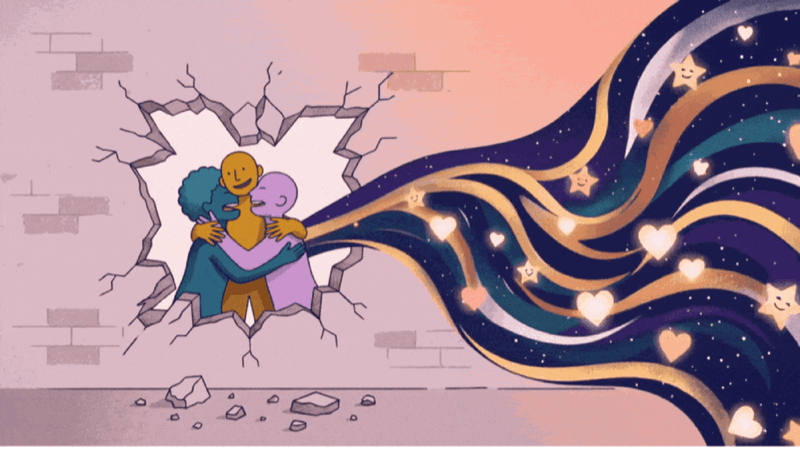
No new treaties or big summits were needed. Just the ability to hear what other people are actually saying. Once that happened, the old idea that we’re too different to get along started to fade in the plain light of shared jokes, shared complaints, shared interests, and shared observations.
The Tower of Babel didn’t come down because of some dramatic strike. It came down because we finally got a practical way for every language to reach every other one.
On the other side, the discovery is straightforward:
We actually like each other.
A lot.