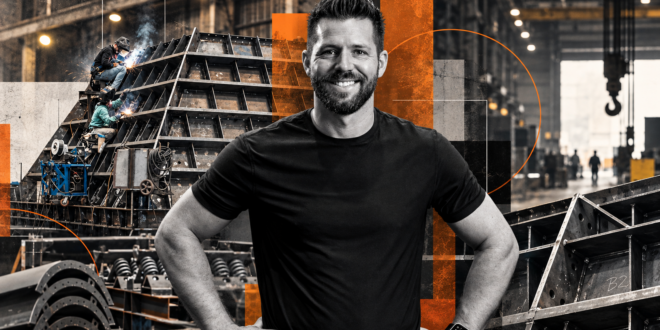
When I asked Andrej Jonovic about the pace of AI, he pointed to a decision many executives are facing now: how long they should commit to outside software when internal capabilities are changing so quickly. His view has become more cautious. A five-year SaaS commitment, he said, no longer feels sensible in a world where AI can materially change what a company can build, adapt, or control in a much shorter window.
“All SaaS contracts should be for a year, at most two,” Jonovic said.
That view came from watching his own team evaluate what was possible when people were physically together, working through a real operating question rather than talking about AI in the abstract. The takeaway was that AI may change the build-versus-buy calculation itself, especially when data control, flexibility, and long-term cost are part of the decision.
That is the practical lens Jonovic brings to enterprise AI, which is why our first question was about what kind of AI conversation enterprise leaders should be having now.
Q&A With Andrej Jonovic
Q
AI is everywhere right now. What kind of conversation do you think is actually useful for enterprise leaders?
A
I think there’s so much noise. You wake up, and you’re inundated with headlines about how AI will do this and that, and then someone else says, in fact, AI won’t do enough. Everybody is talking about the same things, and a lot of it becomes difficult to separate from the hype.
What I think is useful is something more insightful and balanced. I don’t know that I have all the answers, but for us, it’s about where AI actually changes enterprise work. Where does it create visibility? Where does it help an organization operate at scale? Where does it change the decisions leaders make about what to buy, what to build, and how long they should commit?
Q
What matters most when AI is being deployed in the public sector, healthcare, or other highly regulated industries?
A
More so than ever, decisions are anchored around how quickly you can scale and whether you can maintain that scale along with all the standards you have to comply with. In these environments, you are dealing with highly regulated and sensitive topics. You are looking at a lot of sensitive information, so the question is whether AI can work in a way that holds up.
Leaders have to think about scale, standards, cost, and trust at the same time. If the cost base runs out of control, the model becomes hard to justify. If the environment is not secure, speed alone is not very useful. The real test is whether you can operate in a scalable fashion, at the cost base the organization needs, while still complying with the standards that environment requires.
Q
How is AI changing the way leaders should think about long-term software commitments?
A
A number of us spent time recently in the office together, and what we saw further opened our eyes to the possibilities. We were looking at a major software decision and asking the same question a lot of companies ask: which system do we sign up for? The problem was the commitment. Five years is a long time in an environment where internal capability can change in weeks.
I no longer see that as a sensible commitment. All SaaS contracts should be for a year, at most two. In some cases, the answer may still be to buy. In other cases, AI may make it possible to build or adapt something internally faster than leaders would have assumed. That changes the discussion. It is no longer just which vendor has the better product. It is what should we buy, what can we build, where should our data sit, and how long does it make sense to be locked in?
Q
What do you think many CEOs misunderstand when they talk about AI and efficiency?
A
CEOs are supposed to be strategic leaders who execute and deliver results. Those results are measured by investors, markets, and shareholders, and shareholders want to see profitability rising. They want to see the metrics they recognize as good metrics all pointing in the right direction.
I think some CEOs are genuinely interested in what AI can do. I also think some leaders are using AI as another way to talk about workforce reduction. They look at productivity, activity levels, and underutilization, and then they say, “If I’m going to meet my margin, I need to cut this percent.” That may improve margins, but I don’t think it is the same thing as AI transformation. The real question is whether AI is actually changing the operating model and the way work gets done.
Q
You’ve been very clear that companies should be careful about chasing the newest AI model just because it is new. Why?
A
I’m not interested in what the latest LLM can do just because it’s the latest. I’m perfectly happy with what the version before last can do if it achieves what the client needs. If you are always chasing the latest LLM, you are falling into the trap of the foundation model providers, because they are burning through so much cash that they have to keep churning out new products.
For what we do today and what our clients need, a lot can be achieved without the latest and greatest model. Unless you pay attention to the cost, your cost will spiral out of control. Most organizations are very cost-conscious, especially in the public sector or healthcare. People talk about the possibility of what AI can do. They should also be asking whether the approach is cost-sustainable.
Q
How should leaders think about choosing the right level of AI for the work they need done?
A
You have to be savvy, and you have to pick the right LLM for the actual job in front of you. You have to avoid saying, “I want the latest and greatest,” because in many cases, you don’t need it. The LLMs themselves have advanced so much that, for a lot of enterprise work, you’re talking about nuances at this point.
It’s kind of like ordering an Uber. You want to go from point A to point B. You can order the Escalade. It’s great. You’ll sit a little higher up, maybe you’ll have a glass rooftop, and it will cost you $50. You can also order whatever Corolla shows up. You won’t have the rooftop, but you’ll get to the same place around the same time, and it will cost you $20. Leaders need to understand the job they are trying to get done. The right model is the one that can do the work securely, reliably, and at a cost that makes sense.
Q
What role do you think XBP can play for enterprises that know they need to change but do not know where to begin?
A
I think a lot of organizations understand that AI is going to disrupt the way they operate. They may even have a mandate to do something about it. The hard part is that many leaders are still sitting with a very open-ended instruction: deliver something from AI. Okay, but what exactly? Where does it fit? How does it work securely? How does it work cost-effectively? How does it scale?
That’s where I think XBP Global can be useful. In the areas we serve, we have already gone through a lot of those battles. We know the environments, the constraints, the cost questions, and the standards that have to be met. So the role is to help enterprises move from a mandate to an actual operating path that can work inside the business, whether that means choosing the right outside tool, building more internally, or avoiding a commitment that no longer makes sense.
As CEO of XBP Global, Andrej Jonovic leads multinational teams in helping enterprises scale AI-driven workflows, automate repeatable work, and elevate human decision-making. His work focuses on building intelligent value creation blueprints that combine agentic AI, open-source LLMs, proprietary institutional knowledge, and Human-in-the-Loop frameworks to redesign how work is executed across industries and the public and private sectors.
A former transactional lawyer and M&A strategist, Andrej has built a global career at the intersection of technology, strategy, and corporate transformation, with leadership experience across Europe, Asia, and the Americas. Prior to his current role, he served as CEO of XBP Europe and Executive Vice President at Exela Technologies, and held earlier roles at Freshfields Bruckhaus Deringer LLP, Airbus, Avolon, and the HGM family office in London. He was educated at the London School of Economics and American University and is admitted as a Solicitor of England & Wales.
Mikayla Lewis is a seasoned editor, writer, and creative visionary who brings the perspectives of the world’s top executives to life through in-depth interviews and compelling storytelling. view profile