
Visa and OpenAI announced a partnership to bring Visa’s global payment network into OpenAI experiences, allowing AI agents to help people shop, compare, buy and pay with tokenization, agent identification, fraud monitoring, spending limits and approval thresholds.
That changes the role of AI in commerce.

Until now, most executives have treated AI as a tool for assistance. It helped draft, search, summarize, code, organize or route work. Payments create a different level of responsibility. The moment an agent can help complete a purchase, it steps into the commercial life of the company.
A business can delegate work. It cannot delegate accountability without structure.
The executive question is simple: before an agent can spend company money, who decides its limit?
Spending Is a Management Decision
Every payment carries a judgment. An invoice, a software renewal, a supply order or a vendor change may look routine from the outside. Inside the business, each one reflects need, timing, trust and risk.
People understand context that does not always sit neatly inside a system. A purchasing manager remembers which vendor missed the last delivery. A finance leader sees when an invoice feels wrong. An owner knows when a cheap option will create a problem later.
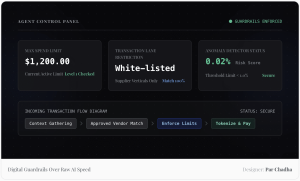
AI agents compress the steps between research and payment. A single flow can compare vendors, recommend a purchase, prepare the order and move toward checkout. That speed is useful only when the lane is defined before the transaction begins.
The mistake would be to treat agentic payments like another software feature. They are closer to delegated buying authority.
My rule for CEOs is this: define the authority before you release the speed.
The Operating Rule: Limit, Lane, Checkpoint, Record
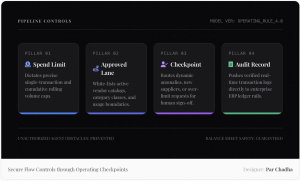
A company should give every payment agent four controls: limit, lane, checkpoint and record.
Limit sets the dollar amount. Lane defines the approved vendors, categories and use cases. Checkpoint determines when a person must approve the transaction. Record gives finance, operations and leadership a clear view of what happened.
That structure avoids two bad outcomes. The agent does not become a free-moving buyer inside the company, and the company does not slow the technology so much that it loses the benefit.
Visa’s direction points to the same practical need. Its agentic commerce work references spending controls, approval thresholds, agent identification and fraud monitoring. OpenAI’s Agentic Commerce Protocol also shows how purchasing can move directly into the AI experience while merchants remain responsible for fulfillment, returns, support and the customer relationship.
For a CEO, the first step should be a decision map. Which purchases are routine enough for automation? Which vendors are approved? Which amounts need review? Which exceptions stop the flow? Which records must be visible to finance and the board?
That map becomes the difference between useful automation and uncontrolled delegation.
The Example: Small Business Capacity
The best place to see the value is a small business.
A small business owner lives inside practical work: AP, cash, deposits, purchase, payroll, taxes, HR and admin. Growth creates more of that work before it creates the management layers to absorb it.
Agentic payments can change the capacity equation. An agent can collect invoices, compare recurring purchases, prepare payment batches and identify unusual changes before cash leaves the company. The owner gets more throughput without adding a person for every task.
Take a restaurant group. The agent can prepare a weekly reorder from approved suppliers, compare the order against prior usage, flag price changes and route anything unusual to the manager. A normal paper-goods order under a set amount can move quickly. A new supplier, a higher quantity or a price jump requires approval.
That is the right division of labor. The agent handles structured work. The person keeps commercial judgment.
Trust Will Decide Adoption
Agentic payments will advance because they solve a real operating problem. Companies want speed, lower friction and more capacity. Small businesses especially need tools that make daily work easier without adding complexity.
The winners will build payment agents that executives can govern without creating another layer of bureaucracy. Clear limits, approved lanes, human checkpoints and useful records will matter more than the demo.
Once AI enters the payment flow, trust becomes an operating system. Speed creates value only when authority is clear.