Over the past few years, AI has gone from a novelty idea with the potential for disruption to a key technology used by businesses of all sizes. Almost every business in every industry uses AI in one way or another, and for a growing number of companies, it’s an integral part of operations.
There’s no denying that AI can speed up work and increase output when used properly. But a recent study shows that reports of increased productivity may overlook the extra toll being paid by managers and leaders.
Last month at Founder Reports, we published our AI in the Workplace report, based on a survey of 2,000+ U.S.-based workers. We set out to learn more about how the rapid growth in AI usage is impacting businesses and employees.
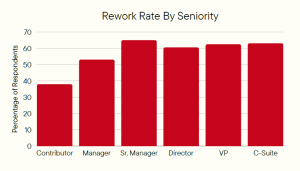
One of the most eye-opening findings is that 57% of those in management positions and above have had to fix work from colleagues who relied too heavily on AI, while only 38% of individual contributors have had to do the same.
AI has clearly sped up work, but the added review time needed by managers and leaders has become a bottleneck for many companies. Just as significant, the extra workload puts leaders at greater risk of burnout.
The Burden Climbs With the Org Chart
The data shows a clear trend that rework is more likely to fall on managers and senior leaders. 53% of managers, 65% of senior managers, 61% of directors, 63% of VPs, and 63% of C-suite executives say they’ve had to clean up other people’s AI-assisted work.
Naturally, managers and leaders own responsibility for output. It’s not surprising that they’re more likely to carefully review and fix any issues before the work goes public or is sent to a client.
Interestingly, the data also shows that leaders themselves tend to be the heaviest users of AI. C-suite executives (62%) and VPs (63%) are more than twice as likely to use AI daily, compared to individual contributors. This shows that the rework isn’t caused by leadership being against AI or resisting change. Instead, it’s the people who are the most familiar with AI tools that are dedicating more time and effort to reviewing and cleaning up the output.
Review Got Heavier and Harder
Managers have always carried responsibility for the work produced by their teams. AI hasn’t changed that fact, and the need for reviewing work isn’t new. But the nature of that review has shifted, and for many leaders, it’s become more time-consuming and more complex.
Riken Shah, Founder and CEO of OSP, a healthcare software development company, says the nature of his review work has “deepened” due to AI. “I spend less time checking for completeness and more time interrogating the reasoning,” he explains.
The challenge many leaders face is that AI-generated work usually looks clean and correct, even when it’s not. Managers can’t casually spot-check for obvious errors.
As a result, review now requires a greater level of scrutiny. Christian Espinosa, Founder and CEO of the medical device cybersecurity company Blue Goat Cyber, says AI output is often “just plausible enough that the person submitting it never stopped to question it.”
Unsurprisingly, data shows that AI-assisted work is reviewed more closely than fully human work. The Founder Reports study showed that 77% of respondents review work from their co-workers more closely if they know AI was used, and 36% review it “much more carefully.”
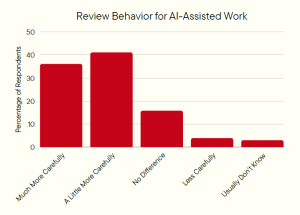
Familiarity with AI tools doesn’t reduce the scrutiny, as 80% of daily AI users said they review AI-assisted work more closely.
The Cost That’s Often Overlooked
Most studies and reports that show AI’s impact on productivity don’t consider the toll it takes on managers and executives. Of course, AI use in the workplace isn’t going away, so companies must adapt their process for reviewing and taking ownership of AI-assisted work.
The burden of review currently falls on managers in most organizations because they’re the ones responsible for the output. The most effective way to lighten the load for managers and leaders is to ensure contributors take ownership of the work they create with AI tools.
Review should happen before the work reaches management, which may be an adjustment from how teams have always functioned before AI.
Additionally, human responsibility is needed even when AI tools are used. Espinosa points out that most of the AI-related errors he sees are due to someone over-trusting the tools. He says, “Over-trusting AI output is still a failure of ownership.”
Policies and procedures should be established to clarify how and when AI tools can be used, and to specify who is responsible for review and who owns the output. Our survey revealed that 44% of workers say their employer has no clear AI usage policy, or they’re not sure if one exists. Clearly, many businesses have adopted AI faster than they have established guidelines for how those tools should be used.
Aside from policies, companies can also reduce the review burden by creating clear examples of what completed projects look like. Teresa Tran, COO at LaGrande Marketing, says that creating an example of finished work is the most effective thing she’s done to reduce her time and effort for reviews. She says that “managers who skip that step end up doing the hard work twice, once when they review and again after they send it back for a full rework.”
The current situation with managers carrying most of the review burden shows what happens when adoption moves faster than processes are developed and adjusted. But there are clear solutions, and some teams are already implementing them. With a few reasonable changes, businesses can benefit from added productivity without dropping all the review work on managers and leaders.