
It seems like every week there’s a new return-to-office mandate making news headlines. Despite the fact that many high-profile companies have shifted their policies to favor the office, remote work is still extremely common.
Bureau of Labor Statistics data shows that 22.7% of US workers worked remotely, at least part of the time, in February 2026. This is the exact same percentage as February 2024, and barely down from 23.7% in February 2025.
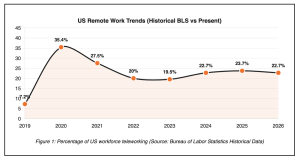
Don’t let the headlines fool you. Remote and hybrid work are still very much alive, and properly managing distributed teams is essential for many company’s success. However, data shows that many leaders are coming up short where it matters the most.
CEOs and leaders of Fortune 500 companies often cite culture and productivity as the reasons why their teams need to be in the office. But workers feel communication is the bigger issue.
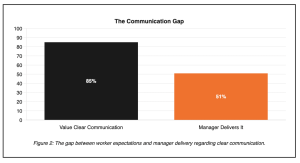
A November 2025 Founder Reports survey of 1,000 U.S.-based remote and hybrid workers revealed that 85% say clear communication is the most important quality in a manager of distributed teams. Only 51% say their manager actually delivers it.
The Scope of the Problem
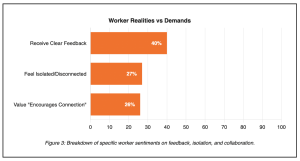
The communication gap goes well beyond that single stat. In the same survey, only 40% of remote and hybrid workers feel they receive clear feedback from management. And 27% say they feel isolated or disconnected from their colleagues.
There’s a telling detail buried in the data, too. When workers were asked which qualities they want from a manager, “encourages collaboration and team connection” came in dead last out of nine options. Only 26% feel it’s an important quality for managers of distributed teams.
Remote workers aren’t asking for more virtual hangouts. They’re asking for clarity in direction, expectations, and feedback.
That distinction matters. The teams that thrive without working in the same location have leaders who understand the importance of communication and proactively build it into their core practices.
Define the Work Before the Work Begins
Marc Bishop, Director of Wytlabs, has a simple practice that addresses the communication problem before it starts. He starts every project with a one page brief that defines the business goal, success metric, and decision owner. “This habit removes ambiguity before work begins and prevents long message threads later,” he says. “When teams know the objective they collaborate with confidence.”
In a traditional office, a lot of alignment happens without deliberate action. You overhear a conversation and pick up context. You read body language in a meeting and adjust your approach. You grab someone in the hallway to ask a quick clarifying question. Remote teams don’t have any of that. Without explicit upfront clarity on what a project is trying to accomplish and who owns the decisions, remote work turns into spiraling Slack threads and misaligned deliverables.
The one-page is cheap and easy to implement. No new software or restructuring are needed. Just writing things down before the work starts.
Go Async-First and Document Decisions
Nikhil Pai, Founder of Chronicle runs a fully distributed team across multiple time zones. He learned early that synchronous communication breaks down when a team’s workday covers 12 or more hours.
“The best thing I ever did for my remote team was to go async-first and document everything,” Pai said. “Not in a bureaucratic way, but in a way where anyone on the team can understand decisions, priorities, and context without needing a meeting.” He noted that without documentation, the same questions kept coming up over and over, and people felt out of the loop. “That’s draining for culture. So we developed a habit of writing things down, from weekly priorities to how we think about product decisions.”
Documentation also has a secondary benefit that’s easy to overlook. It functions as passive feedback. When priorities, decisions, and reasoning are written down and accessible to the whole team, employees can use it as a standard and compare their work to it.
Invest in Strategic In-Person Time
Even the best async systems have limits. Some things are hard to build through a screen, and relational trust is one of them.
María José Lorenzo, Director of Near, leads a remote team of more than 60 people. Her company invests in one annual in-person offsite each year, and she sees the effects carry forward long after the event ends. “The impact of that face-to-face time carries across the whole year,” Lorenzo said. “People become more comfortable and more direct with each other, and it creates a real sense of belonging.”
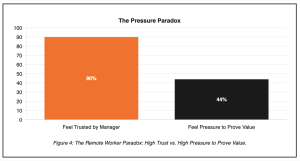
The offsite works because it builds the kind of relational trust that makes async communication, written feedback, and honest disagreement possible during the other 50 weeks of the year. There’s a relevant tension in the Founder Reports survey data that comes into play here as well. 90% of remote workers say they feel trusted by their manager, but 44% still feel added pressure to prove their value as remote employees. Face-to-face time is one of the few things that helps close that gap.
Many remote companies have already seen the benefits of gathering the entire team together. CEO Shawn Rubel said Vecteezy’s off-site meeting enhanced relationship building. “People felt more comfortable with each other, and that showed up in how work got done afterward.”
When Communication Breaks Down, Conflict Goes Underground
Kari Brooks, CEO of Treehouse, has noticed something about remote teams that doesn’t get talked about enough. Poor communication doesn’t just slow things down. It makes people avoid conflict altogether.
“Culture becomes most visible during disagreement,” Brooks said. “When teams are spread out, unresolved issues can sit quietly in Slack threads or email chains for weeks. If two teams see a problem differently, we bring the decision owners together quickly instead of letting it linger.”
When people don’t have clarity on how to raise issues or who owns a decision, they tend to tiptoe around disagreements rather than work through them. Problems don’t disappear. They just go unspoken until they’re bigger and harder to fix.
The communication gap has consequences that go well beyond efficiency. It changes how teams handle friction, and in a remote setting, silence can look a lot like alignment when it’s actually avoidance.
The Real Question
The remote work debate has been dominated by factors like culture and productivity. The Founder Reports data suggests a more important issue is how well leaders communicate with their teams. The communication gap is a structural weakness, and it’s hiding in plain sight at a lot of companies.
The tools exist. One-page briefs, async documentation, strategic offsites, fast conflict resolution. None of them are expensive or complicated. But they do require intentionality. The companies that systematize communication, that treat it as an operating system instead of something that should just happen on its own, are the ones that will make remote work hold up over the long term.