
I ordered my dog’s favorite chow on Instacart. The inventory system showed it was available. The shopper arrived at the store, walked to the aisle and found an empty space where the item should have been.
The app could not solve the problem. The inventory system had already given the wrong answer. The shopper had to ask a manager, wait while someone checked the back room and decide whether the order could still be completed.
The exact product was found.
In this scenario, Instacart would have deployed computer vision and predictive AI at four key stages: pre-order inventory, out-of-stock prediction, smart replacement, and in-store navigation. This includes using “Store View” for real-time shelf tracking, machine learning for availability forecasting, automated replacement algorithms, and optimized routing for in-store picking.
While these AI systems aim to bridge the digital-physical gap, the scenario correctly identifies that physical disruptions, such as misplaced items, still require human intervention.
Human’s are required for the last mile of reality.
The future of AI will not belong only to companies that build autonomous agents. It will belong to companies that know when autonomy needs human judgment.
The Agent Boom Is Running Into the Real World
An AI agent can plan a task. That does not mean it can complete the task in the messy conditions of the world. It may know what should happen, but not what actually happened. It may know the route, but not the road closure. It may know the store inventory, but not the box sitting in the back room. It may know the policy, but not the customer’s mood.
An agent may choose the right office furniture. It still cannot assemble the desk. It may book a restaurant. It still cannot walk into the private room and decide whether the setting feels appropriate for a sensitive meeting. It may select a product. It still cannot ask a store employee to check the back room.
The agentic last mile is not just delivery.
It is completion.
This distinction matters because much of the AI industry still talks as if intelligence ends at the screen. It does not. Most valuable work eventually touches a customer, a room, a device, a shipment, a regulation, a team or a local condition. The more agents act in digital systems, the more they will need reliable ways to interact with human reality.
Navigation apps offer a useful comparison. Digital maps became more valuable when they absorbed live human input. A driver reports a crash. Another flags a closed lane. Someone notices a police vehicle or a hazard. The map improves because local people correct the system in real time.
AI agents will always need a human feedback layer.
They will need people who can see what software cannot see, verify what data cannot prove and handle exceptions that do not belong inside a clean automation flow.
Human Quality Control Is Becoming Part of the AI Stack
Companies often enter AI adoption with a simple assumption: automation will remove labor.
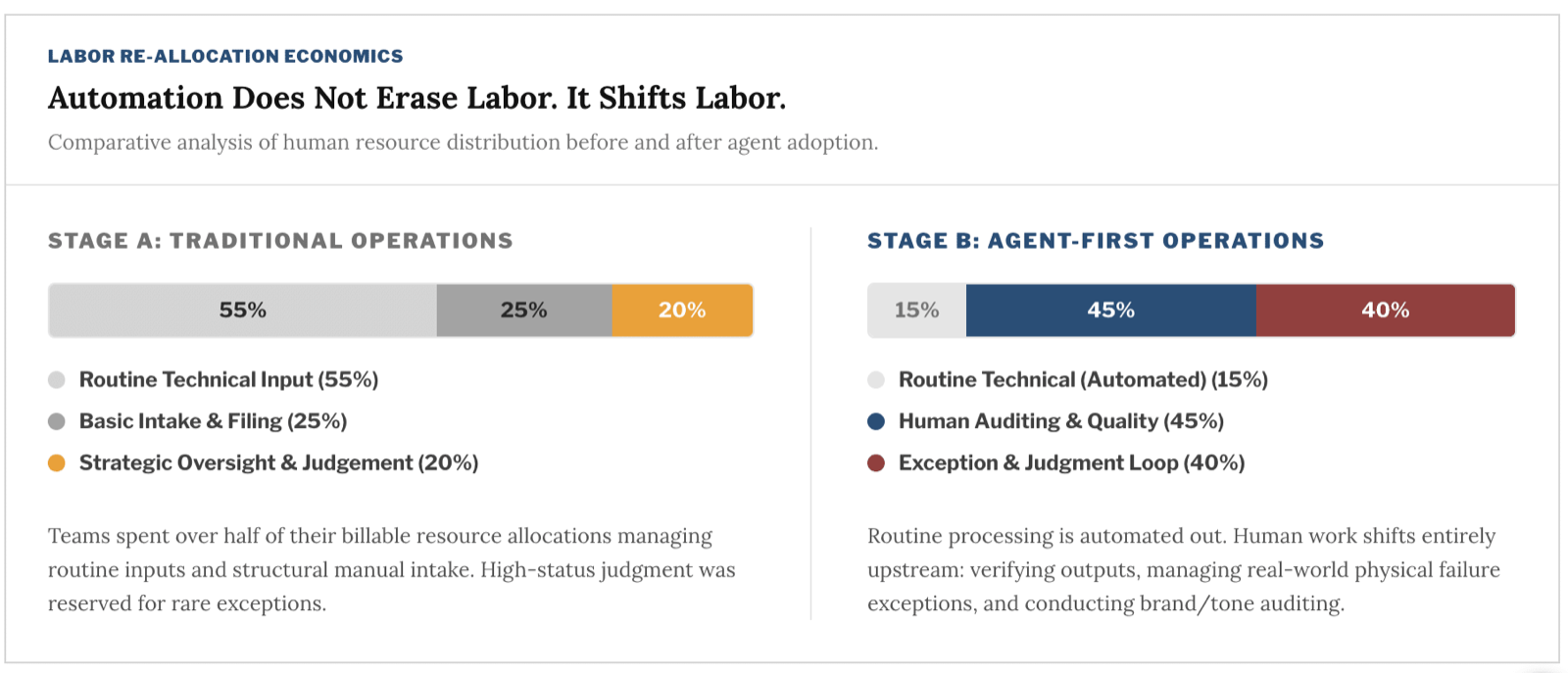
In practice, automation often moves labor.
The work does not always disappear. It shifts toward oversight, correction and judgment. A human trait.
Gartner has projected that more than 40% of agentic AI projects will be canceled by the end of 2027 because of rising costs, unclear business value or weak risk controls. Gartner also predicted that 33% of enterprise software applications will include agentic AI by 2028, up from less than 1% in 2024.
Both claims can be true. Agents can become widespread, and many early agent projects can fail.
The likely dividing line will be operational discipline.
Companies that treat agents as magic workers will run into cost, quality and trust problems. Companies that build human review into the system will have a better chance of making agents useful.
Human quality control will not be limited to fact-checking. It will include tone, taste, usability, realism, feeling, compliance, cultural fit and customer experience.
Does this voice sound natural?
Does this image feel authentic?
Does this recommendation make sense for the person, place and moment?
Does the workflow succeed after it leaves the screen?
Is it truly a good job?
Those questions require people.
What to Implement Into Your Agentic Environment
The higher-value market is not about assigning people random chores from machines. It is about connecting intelligent systems to human capabilities they cannot reproduce alone.
Three categories are likely to define this market.
- Human training. AI systems need richer data about how people speak, move, decide, hesitate, correct themselves and perform ordinary tasks. That includes voice data, field observation, user testing, embodied demonstrations and domain-specific feedback.
- Agentic last-mile execution. As agents initiate more work, they will need people who can complete tasks requiring physical presence, local knowledge, exception handling or personal judgment.
- Human quality control. As companies rely on AI-generated work, they will need people who can audit, correct and improve outputs before they reach customers, regulators or the public.
The word is judgment. Another human trait.
A chef does not merely follow a recipe. A good chef adjusts to heat, timing, ingredients, presentation and the people at the table. An interior designer does not merely buy furniture. A good designer understands light, space, movement and taste. A field researcher does not merely collect information. A good researcher knows what changed, what matters and what a remote system would miss.
AI needs that kind of human layer.
MORE FOR YOU
Human Imperfection Is Important
The synthetic internet is making perfection suspicious.
Generated images can look too smooth. AI voices can sound almost right but emotionally flat. Automated writing can be clear and empty at the same time. The closer machines get to realism, the more valuable small human irregularities become.
A pause matters.
A voice crack matters.
A local phrase matters.
A preference that seems inefficient may matter.
Human anomaly is not always noise. In many contexts, it is the proof of reality.
That matters for AI development. Systems trained only toward efficiency may miss what people actually value. A customer may not want the fastest solution. They may want the solution that feels appropriate. A patient may not want the shortest explanation. They may want the one that sounds careful. A shopper may not want the default substitution. They may want someone to understand why the original item mattered.
The more AI enters human-facing work, the more the industry will need people who can evaluate not only whether something is correct, but whether it feels right.
What Leaders Should Ask Now
The next wave of AI evaluation will require better questions.
Where does the agent stop?
Who verifies the work?
What happens when software reaches the physical world?
Which tasks require local context?
How does the system learn from human corrections?
Can the business prove efficiency after accounting for oversight, review and exceptions?
These questions separate AI theater from AI operations.
The first phase of generative AI rewarded companies that showed what machines could produce. The next phase will reward companies that prove what intelligent systems can complete.
That future will not be fully autonomous. It will be coordinated.
The winners will not be the companies pretending people are out of the loop. They will be the companies that design the loop well.